
Published in The Astrophysical Journal Letters · 16 Sep 2026
An international team led by Andrea Bernardi, a YEMS PhD student at Universidad Diego Portales, has confirmed Elias 2-24 b, the youngest exoplanet detected to date. With a mass similar to Jupiter’s and an age of less than one million years, the planet remains embedded in the disk of gas and dust where it is forming.
Bernardi carries out his doctoral research as a member of the Millennium Nucleus on Young Exoplanets and their Moons (YEMS), funded by Chile’s Agencia Nacional de Investigación y Desarrollo (ANID) through the Millennium Science Initiative. The study was published in The Astrophysical Journal Letters and featured in NASA’s September 16, 2026 press release.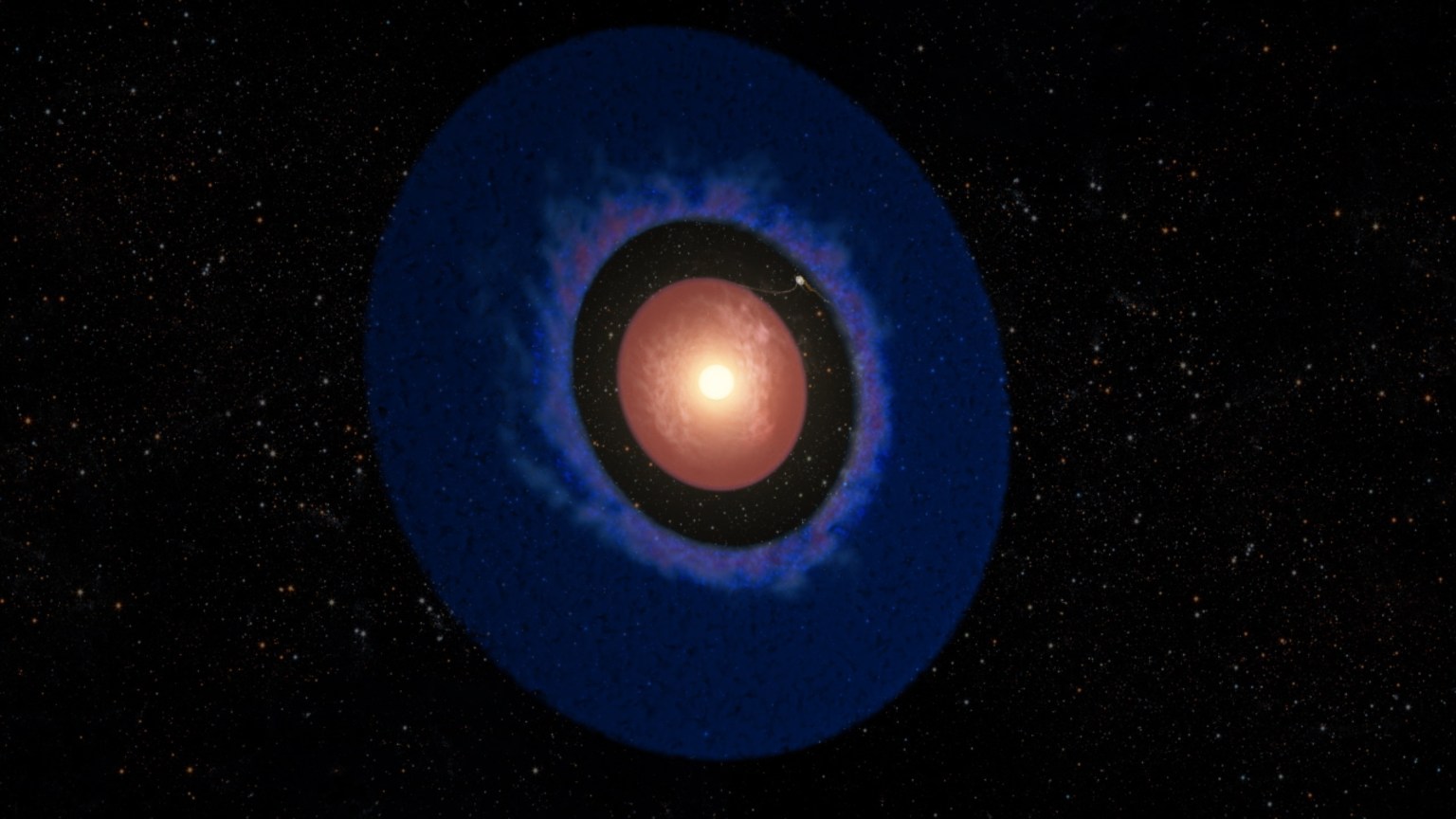
Artist’s impression of Elias 2-24 b. Credit: W. M. Keck Observatory/Adam Makarenko, via NASA Science.
A planet in the gap of its natal disk
The Elias 2-24 system lies about 450 light-years from Earth. ALMA observations revealed a gap in the dusty disk surrounding the star; ESO’s Very Large Telescope (VLT) subsequently detected a faint point of light within that gap. Whether the source was truly a planet remained to be established.
“The planets should be found within the gaps, since they are carving them,” Bernardi says in the NASA release. “And that’s exactly where we found Elias 2-24 b.”
Confirmation in the Keck archives
The team identified the same source in observations from 2018 and 2020 preserved in the NASA-funded W. M. Keck Observatory Archive. Combining the data and tracking its motion over time provided evidence that the source was a planet, rather than an imaging defect or a background star.
Bringing ALMA, VLT and Keck observations together connected the disk’s structure with the object shaping it. The result also demonstrates the value of astronomical archives: observations obtained years earlier can supply the evidence needed to confirm a new world.
A window into planet formation
Elias 2-24 b orbits at roughly 55 times the Earth–Sun distance from its star. Building a giant planet so young and so far from its star challenges planet-formation models. According to NASA, the previous record holders for the youngest known planets were more than five million years old.
The dust surrounding these worlds makes them difficult to detect. “We are mostly blind to these baby planets right now,” says study co-author Lucas Cieza in the NASA release.
“It is exciting to add another system to the very small sample of planets we can study while they are still forming. These systems give us a rare opportunity to confront planet-formation models with the process itself, rather than only with its end products,” says Sebastián Pérez, YEMS researcher at Universidad de Santiago de Chile.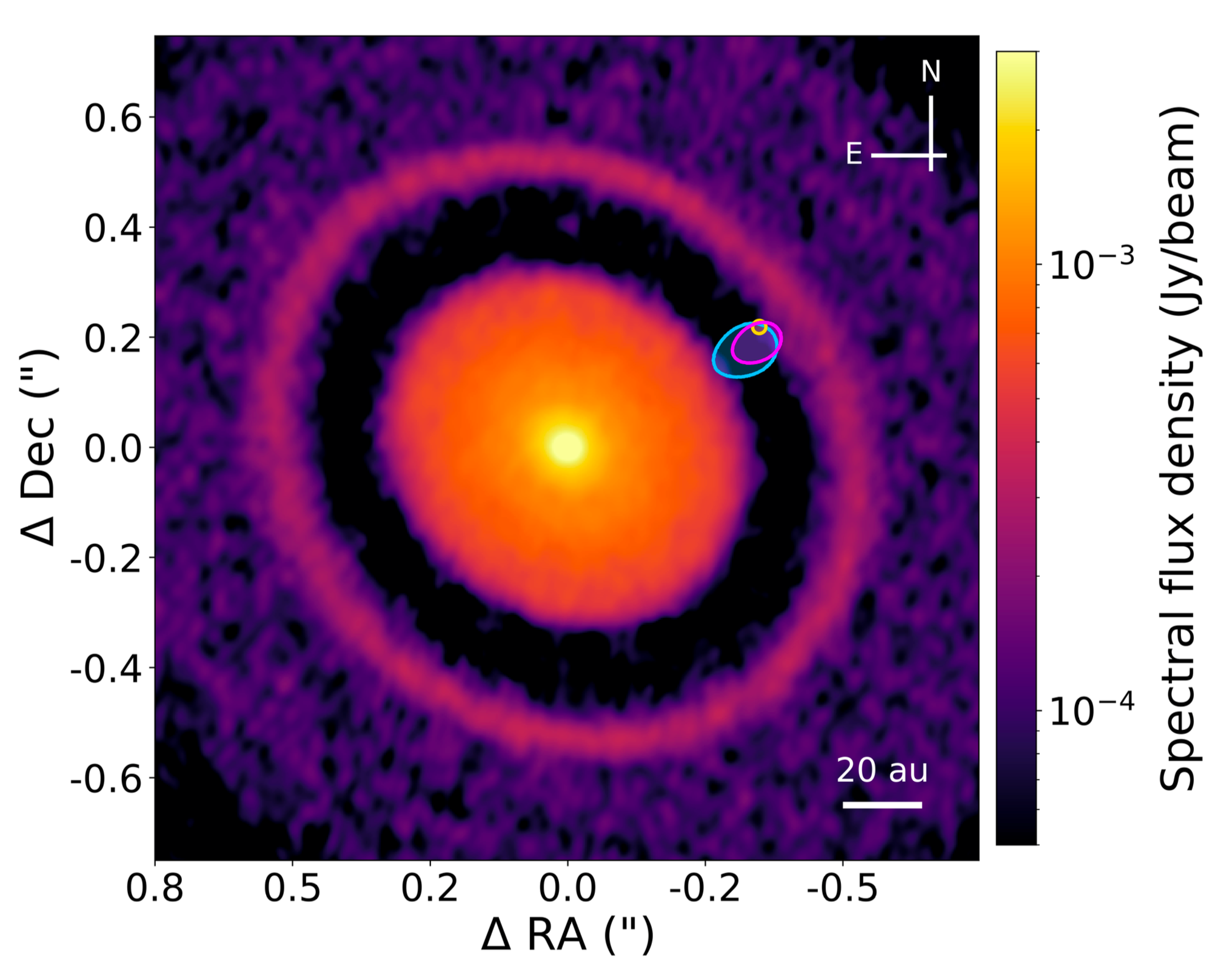
ALMA 1.3 mm continuum observation from the DSHARP survey. The magenta, blue and gold regions represent the area enclosing the companion’s position according to the study’s results and previous literature claims. Elias 2-24 b is responsible for the gap and the accumulation of dust at the inner edge of the outer disk. Credit: Bernardi et al. (2026).
Source: NASA Science, “Newfound ‘Baby’ Planet Smashes Record for Youngest Known World”.