
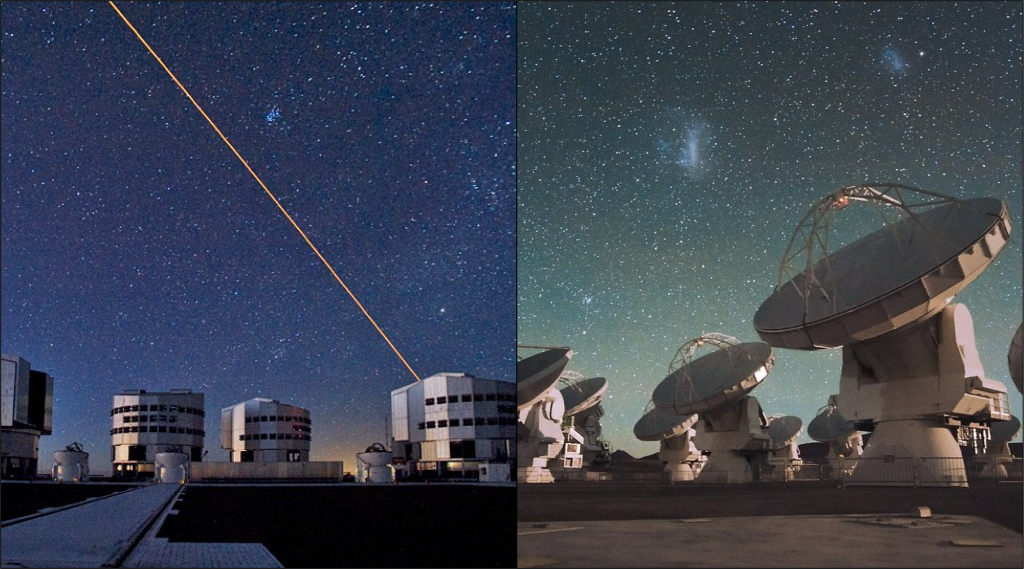
The research groups at UDP´s Instituto de Estudios Astrofísicos (IEA) will get new data to learn more from planetary systems to distant galaxies.
Planetary Systems
Prof. Lucas Cieza is a co-PI of one of the Large Programs recently approved by ALMA for Cycle-13. The project, called “PEBBLES” (Protosolar-system Environments with BroadBand Look at Evolution of Solids), will perform multi-wavelength observations of 24 protoplanetary disks in Bands 2, 6, and 7 at ~0.06 arcsec resolution in order to investigate the solid mass budget, dust evolution across substructures, and whether outer pebble properties regulate the composition of the inner disk. With over 100 hs of ALMA time, PEBBLES will deliver the first homogeneous broadband view of pebble distributions on Solar-System scales and establish an observational bridge between ALMA and JWST. The PEBBLES team also includes recent IEA graduates Grace Batalla, Prachi Chavan, and Camilo Gonzalez.
Stellar and Galactic Astronomy
Prof. Paula Jofre is the PI of an observing run of 37 hours with FLAMES at the VLT to observe 100 stars of the nuclear star cluster (NSC) located in the Sagittarius galaxy, M54. The high resolution and signal-to-noise data will allow for a detailed chemical characterization of these stars, which are needed to perform a phylogenetic study of the cluster. NSCs are believed to be a mix of stellar populations whose origins remain unknown but have information about the early stages of galaxy formation. Disentangling the various stellar families in NSC is difficult but important, and methods adapted from population genetics have shown to be promising. This is part of the interdisciplinary phylogal collaboration which joins mathematicians, biologists and astronomers.
Extragalactic Astronomy
Prof. Evelyn Johnston is the PI of an observing run of 84 hours with MUSE on the VLT to observe 42 nearby elliptical galaxies. Elliptical galaxies are often considered to be simple systems, but recent works have modelled their light profiles and found that they actually require multiple components to create the best fit. But it is still uncertain what these components are. One theory is that they are extended structures that have formed through different mechanisms in the lifetime of the galaxy. With the MUSE data we will apply light profile fitting as a function of wavelength throughout the datacubes to model these components and extract their spectra, which will be used to measure the stellar populations and star formation histories, giving us key insights as to how these galaxies formed. A pilot study of three galaxies observed with MUSE was carried out by our team in Jegatheesan et al (2025), which found that the central concentrated component formed through an early dissipative collapse while the outer extended envelope was built up slowly through accretion of other galaxies. Thus, this study will be the first spectroscopic analysis of the different components in a large sample of elliptical galaxies in different environments, and will help us understand the different formation mechanisms of these objects.
Dr. Alessandro Peca is the PI of an ALMA observing programme to map the cold molecular gas reservoir of ESP 39607, a luminous obscured AGN at (z=0.201), through spatially resolved CO(2–1) observations. The growth of supermassive black holes is regulated by the availability, transport, and removal of interstellar gas, yet the cold molecular phase connecting galaxy-scale reservoirs to nuclear accretion remains poorly constrained, especially in luminous obscured AGN. ESP 39607 provides a unique laboratory for studying this connection: it hosts a rare ultra-fast X-ray inflow, extended AGN-ionised [O III] emission spanning tens of kiloparsecs, and a powerful 200 kpc radio jet, while residing in a relatively undisturbed early-type host without obvious large-scale structures capable of efficiently funnelling gas inward. The ALMA observations will measure the molecular gas mass and resolve its distribution on kiloparsec scales, determining whether a central cold-gas reservoir is available to sustain SMBH growth. By comparing the CO morphology with existing ionised-gas and radio data, we will test for signatures of AGN feedback and jet–ISM coupling, providing the first resolved cold-gas view of an obscured AGN hosting a confirmed ultra-fast inflow and powerful multi-scale feedback signatures.