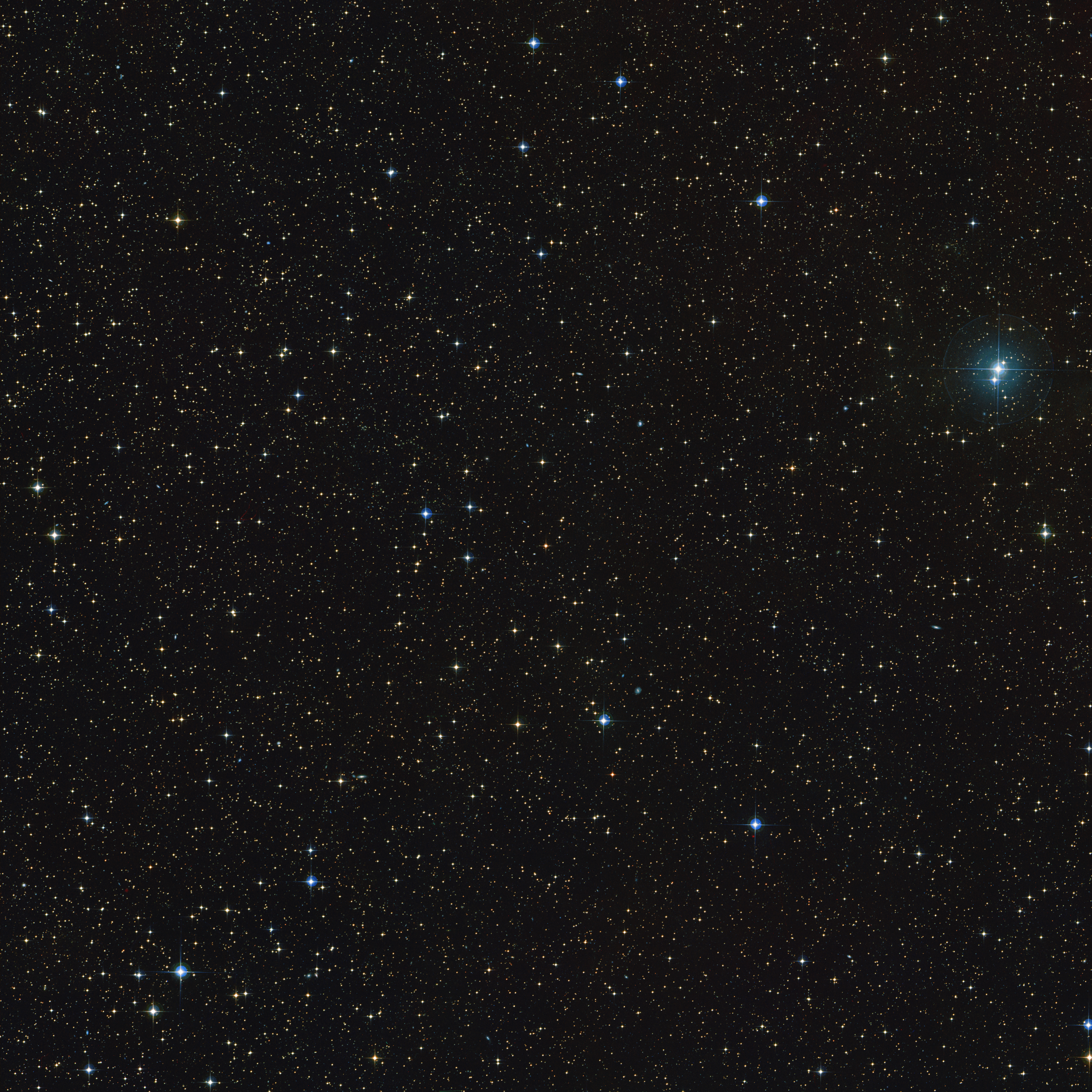
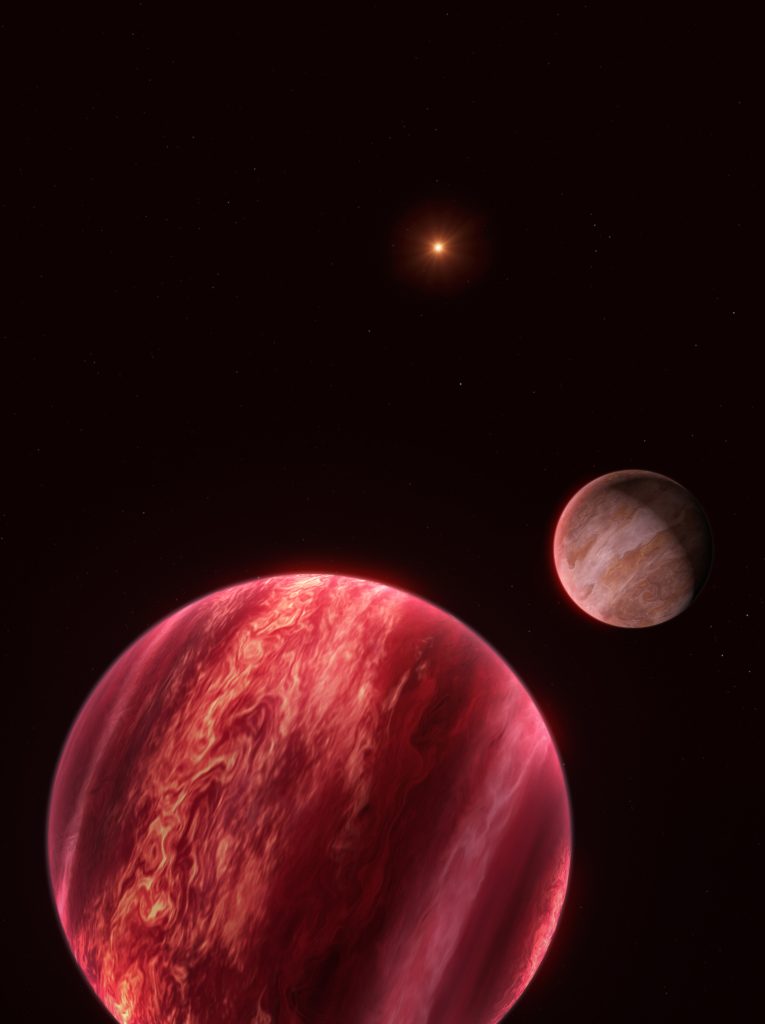
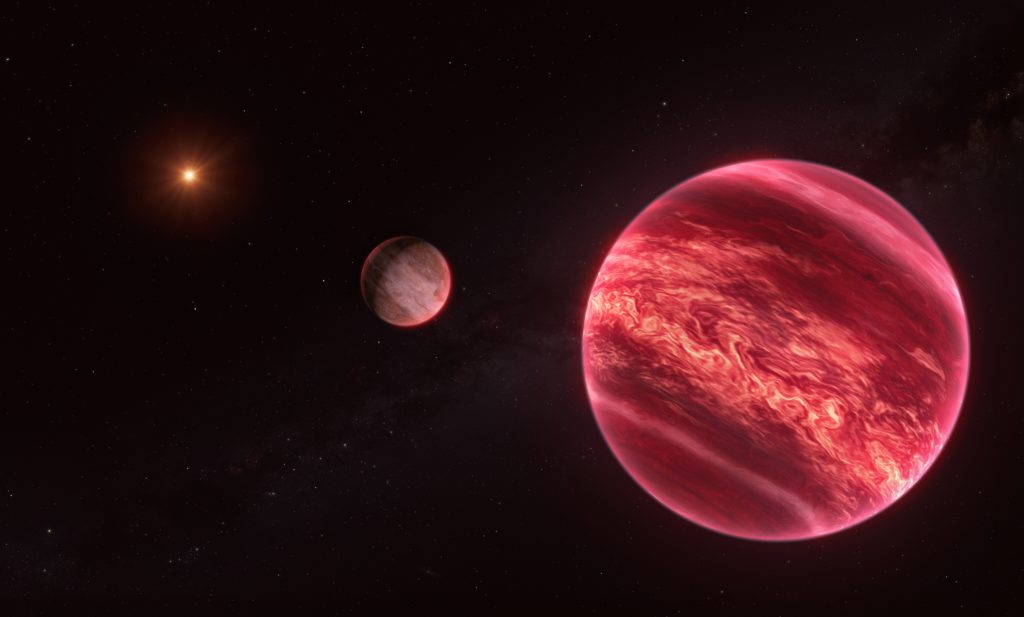
Observations made with the European Southern Observatory’s Very Large Telescope (ESO’s VLT) have revealed evidence for a moon-like object in the CD-35 2722 system. Unlike moons in our Solar System, the newly found object does not orbit a planet, raising questions about what to name it. Instead, it circles a brown dwarf, an object larger than a planet, that orbits the CD-35 2722 star. If confirmed, this could be the first ‘moon’ discovered outside our Solar System.
Kevin Hoy, an ESO student in Chile and lead author of the study published today in Nature, describes the system he spent months analysing as “super weird” compared to our own. The biggest and most massive object in this young system is the star CD-35 2722, which has about half the mass of the Sun. The star is being orbited by a brown dwarf, an object too massive to be a planet but too small to be a star. The newly discovered object orbits this brown dwarf.
“This system is somewhat hard to define using Solar-System-based words like ‘planet’ and ‘moon’,” states Hoy, who is also affiliated with the Universidad Diego Portales and the Millennium Nucleus of Young Exoplanets and their Moons (YEMS) in Chile. The new object, which the team call an exosatellite, is at least as massive as Jupiter while the brown dwarf has more than 30 times the mass of Jupiter. “The exosatellite is clearly massive enough to be a planet, but it does not orbit a star, though it orbits an object that orbits a star,” says Hoy. “Being the third wheel in this system makes us want to call it a moon, even if it is nothing like the small, rocky moons we have in our system.”
This exosatellite or ‘exomoon’, a natural satellite outside our Solar System [1], is difficult to label, given the differences in this system compared to our own. Alice Zurlo, YEMS Director and collaborator on the study explains: “The satellite we report is a giant gaseous body orbiting a highly massive companion, itself several times the mass of Jupiter.”
“We have a clear delineation between the planets and the Sun in the Solar System, so defining things like moons is simple. In the CD-35 2722 system, where we are blurring the lines between stars, planets, and moons, the whole thing becomes more complicated to describe,” adds Zurlo, who is also an astrophysicist at Universidad Diego Portales.
Regardless of what to call this object, astronomers have been trying to detect satellites outside our Solar System for years, but none has yet been confidently detected. Therefore, despite the over 6000 exoplanets discovered to date, only a few exomoon candidates have been spotted and the evidence to support them is limited. Just a few months ago, a team led by Quentin Kral reported on observations with ESO’s Very Large Telescope Interferometer in the HD 206893 star system, which revealed hints of a satellite, but no firm detection.
For the CD-35 2722 observations, Hoy, Zurlo and their team used the CRIRES+ instrument on ESO’s VLT, employing the method that was used to find the first exoplanet around a Sun-like star. They applied this radial velocity method to detect small wobbles on the brown dwarf caused by the object orbiting it, finding what the team believe to be strong evidence for this ‘moon’. “As exotic as it is, this system is truly unique and represents a breakthrough: the first plausible detection of an exosatellite,” says Zurlo.
Beyond the excitement of discovering new types of objects, detecting satellites in other planetary systems can help us understand how diverse their formation and evolution might be. With its 39-metre mirror and advanced instrumentation, ESO’s upcoming Extremely Large Telescope (ELT) will allow astronomers to detect smaller exomoons. Discoveries with the ELT will make us further reconsider how we label planetary objects from systems different from our own.
[1] A satellite is an object that orbits another object and it can be natural (like our own moon) or artificial (like a spacecraft). An exosatellite is a satellite outside our Solar System. An exomoon is generally considered to be a natural satellite orbiting a planet or another object outside the Solar System, though there is no officially accepted definition for exomoon.
More Information
This research was presented in a paper titled “Planetary-Mass Exosatellite Detected Around a Star’s Substellar Companion” to appear in Nature. (doi:10.1038/s41586-026-10751-w).
The team is composed of K. Hoy (Instituto de Estudios Astrofísicos, Facultad de Ingeniería y Ciencias, Universidad Diego Portales, Chile [Diego Portales]; European Southern Observatory, Chile [ESO Chile]; Millennium Nucleus on Young Exoplanets and their Moons, Chile [YEMS]), A. Zurlo (Diego Portales; YEMS), P. A. Peña R. (Diego Portales; Centro de Astrofísica y Tecnologías Afines, Chile [CATA]), J. Köhler (TLS Tautenburg, Germany), S. Desidera (INAF Osservatorio Astronomico di Padova, Italy [INAF Padova]), R. Gratton (INAF Padova), C. Lazzoni (INAF Padova; YEMS), S. Petrus (NASA Goddard Space Flight Center, USA; YEMS), F. Rodler (ESO Chile), J. Smoker (ESO Chile), V. D’Orazi (Dipartimento di Fisica, Università degli Studi di Roma Tor Vergata, Italy; INAF Osservatorio Astronomico di Roma, Italy), I. Carleo (INAF Padova), I. Giovannini (Dipartimento di Fisica e Astronomia, Università degli Studi di Padova, Italy; Diego Portales; INAF Padova; YEMS).
[Webteam: please include ‘Press releases: ESO’ boilerplate here.]
Links
- Research paper
- Source: www.eso.org
Contacts
Kevin Hoy
[email protected]
[email protected]